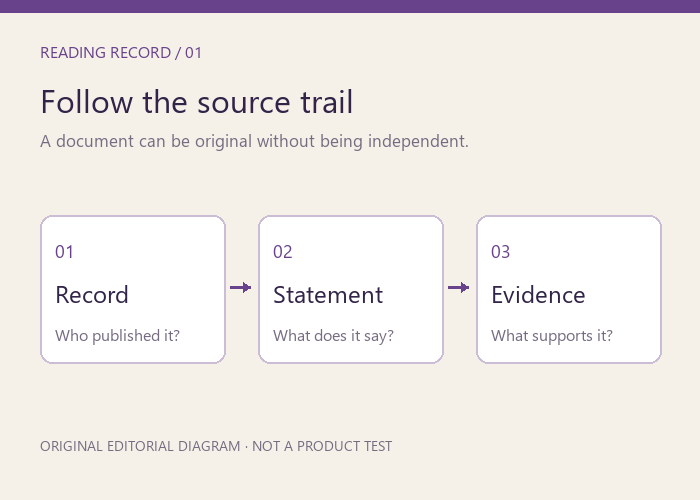
A useful source trail connects a statement to an identifiable document, shows who produced that document, and preserves the limits of what it establishes. Before trusting a brand document, record its publisher, exact subject, date or version, original URL and supporting evidence. If a link in that chain is missing, keep the gap visible rather than replacing it with an assumption.
This is a reading method for public documents, with the limits of documentation analysis kept visible. It does not certify a product, confirm a laboratory result or turn a manufacturer’s statement into an independent finding. It helps an adult reader decide what can be attributed accurately, what still needs checking, and where to look next.
Start with one sentence, not a whole reputation
A page may contain a model name, a component description, a numerical claim and a broad statement about quality. Those are different questions. Choose the specific sentence you want to understand before assessing the entire website. Otherwise, a convincing answer to a small identity question can quietly become a much larger conclusion about performance.
Write the sentence in your notes, together with the heading under which it appears. Then identify the subject. Does it describe a product family, an exact model, an accessory or a regional edition? Our reading glossary provides vocabulary for keeping those scopes separate. A missing model identifier is a reason to narrow your description, not an invitation to choose the nearest-looking item.
For example, suppose a fictional page says that a component is included in a kit. The immediate question is whether the page identifies that kit and edition. It does not yet answer whether the component is sold separately, fits another model or has been independently tested. This example is illustrative; it is not a report about a particular brand.
Distinguish the publisher, the origin and the check
The publisher is responsible for the document you are reading. The origin is the earlier record from which a statement may have been copied or derived. An independent check is separate evidence that actually examines the relevant point. One organization can occupy more than one role, but the roles should not be merged without explanation.
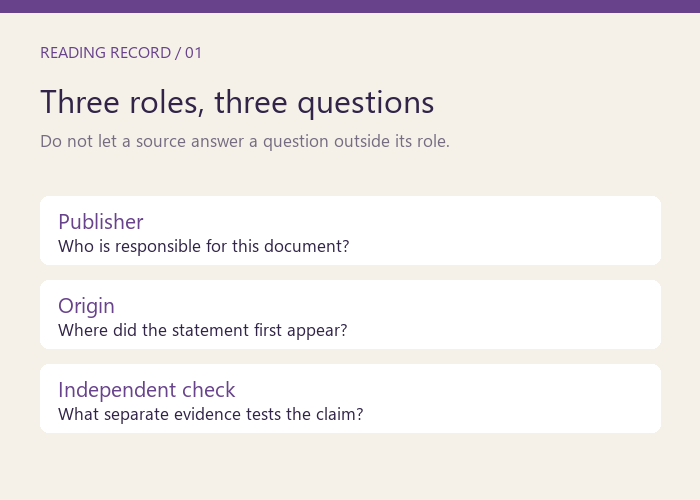
Keep three short questions beside the page: who is speaking, where did this information come from, and what would test it? An official brand page can establish how that brand describes a model. That role is useful and limited. A repeated description on another site may show distribution of the wording without adding a separate observation.
The W3C PROV primer models provenance through the things, activities and agents involved in producing information. Readers do not need to implement its technical vocabulary to benefit from the distinction. A practical note can simply identify the document, the organization and any stated derivation.
Our editorial reading method uses the same discipline of separating a source from the conclusion drawn from it. Follow an attribution as far as the accessible record allows. If the earlier document cannot be located, write that limitation explicitly. Do not describe a quoted result as a test you have reviewed when you have only seen a summary.
Build a record that another reader can repeat
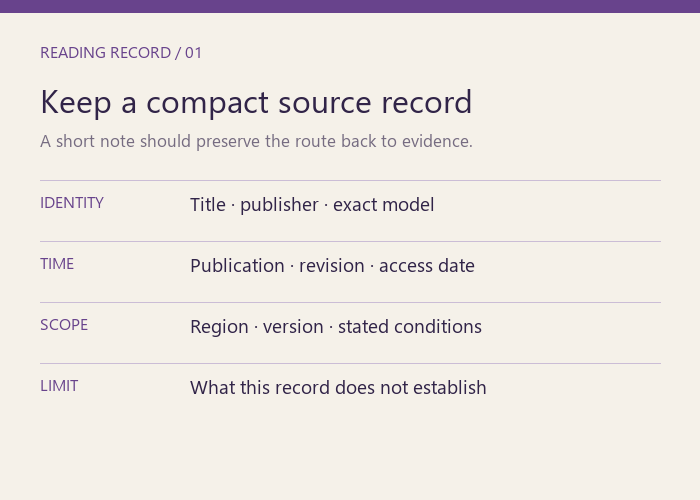
A useful note is compact enough to maintain and detailed enough to revisit. The following checklist is an editorial tool, not a scoring system. It does not assign automatic credibility points to a domain name or punish a document simply because one field is absent.
| Field | What to record | Question it preserves |
|---|---|---|
| Document identity | Title, publisher and original URL | Which record did I read? |
| Exact subject | Model, component or document identifier | What does this sentence concern? |
| Time | Stated publication or revision date, plus your access date | Which point in time does my note describe? |
| Scope | Region, edition, audience and conditions | Where does the wording apply? |
| Support | Linked report, method or attributed source | What evidence can I inspect? |
| Limit | Missing information and conclusions not established | Where should my account stop? |
Separate the date printed on the document from the date you visited it. If the page does not state a publication or revision date, mark that field as unstated. Your visit date still records when you saw the wording; it does not supply a missing publication date. Preserve the exact URL rather than a search-results link that another reader may be unable to reproduce.
Cornell University Library’s source-analysis guidance starts with the bibliographic record, including publisher, publication date and author affiliations. That is a useful first pass. The source record then needs to be connected to your particular question: even a well-identified document may not contain the evidence needed for the claim you are examining.
Read outward before reading more deeply
When the publisher is unfamiliar, pause the close reading and inspect its identity through other accessible records. Look for an attributable organization, a description of its work and a reason it would know about this subject. A polished design or a familiar-looking name should not substitute for that check.
Harvard’s guidance on evaluating web sources asks readers to consider credentials, purpose, currency and coverage. These are prompts for investigation rather than a universal trust formula. For a brand document, a useful application is to ask whether the page presents the publisher’s own specification, a distributor’s summary or an analyst’s interpretation.
Next, open the cited support. Check whether it discusses the same object and conditions as the sentence on the page. A report about a different edition can be useful context while still failing to establish the specific point. The source directory helps distinguish broad institutional context from records that directly concern a subject.
Keep original evidence separate from independent evidence
An original document is not automatically a neutral one. It may be the best available record of what its creator said while remaining incomplete for other purposes. Equally, a secondary explanation may be valuable if it clearly identifies and interprets evidence rather than merely reproducing promotional wording.
UC Berkeley’s primary-source research guide asks readers to examine the creator, audience and purpose, and to verify details against other accounts. Applied here, that means preserving the source’s role. A brand document can be cited as a brand document; it should not be introduced as independent verification of itself.
Compare the language of apparently separate pages. Identical sequences, identical omissions and a shared attribution can suggest a common source trail. They are reasons to investigate the relationship, not proof that an organization acted improperly. Count the evidence you can identify, and avoid treating the number of URLs as the number of independent observations.
Our note on claim, observation and interpretation explains a related distinction. Here the task is narrower: preserve who said what and which record supports it. The source trail should make that distinction easier to check later.
Use the missing field to choose the next action
A missing version calls for a version check. An unclear publisher calls for an identity check. An absent method calls for a search for the underlying method or report. Naming the missing field turns general doubt into a practical next step, and prevents hours of unrelated browsing from being mistaken for progress.
The University of Illinois Library’s source-evaluation guide considers both bibliographic details and content. For this workflow, ask whether the available source fits the precise question. A document can be relevant to naming and irrelevant to a performance measurement. Recording that boundary is more useful than assigning one permanent label to the entire site.
If no suitable record is accessible, write a restrained conclusion: the reviewed page states the point, but the supporting document was not available for inspection. If a later record resolves the gap, update the note with the new evidence. Our editorial standards explain why the wording of a conclusion should follow the evidence actually reviewed.
Reader questions
Does an official website settle every question?
No. It is a direct source for the publisher’s own description. Other questions may require a report, a separate observation or a record with a different scope. Identify the question before deciding which source can answer it.
Should I reject a document with no visible date?
Record the missing date and consider whether time matters to your question. A stable definition and a changing specification have different needs. Keep your access date separate, and avoid calling the document current without supporting evidence.
How long should a source note be?
Long enough to recover the document, identify the relevant sentence and preserve its limits. A short structured entry is often more useful than a long impression of the page. Another reader should be able to follow the route and see where verification ends.
Record boundary
This article belongs to our public-source documentation collection. It does not certify a device, provide personal product advice or report physical measurements.
Corrections & revisions